Stakeholder Engagement
The Tokyo Seimitsu Group believes that continuous, active, two-way communication with various stakeholders is important in creating business value and social value while fulfilling our social responsibilities. By sharing information on real needs and issues through sincere communication with stakeholders, we seek to build strong and deep relationships of trust and grow together.
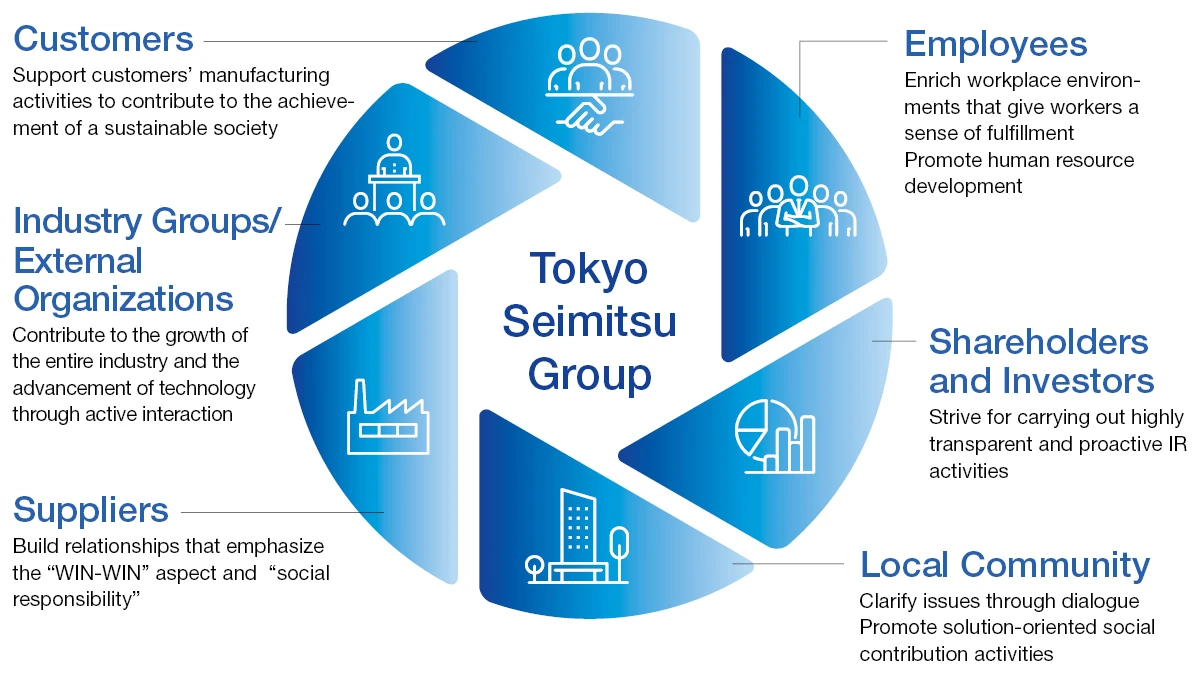
Establishment of the Multistakeholder Policy
In our corporate management, we aim to achieve significant growth together with our diverse stakeholders, including employees, business partners, customers, local communities, shareholders, and investors, through “WIN-WIN” relationships. Additionally, we will appropriately distribute profits and value generated through value co-creation and productivity improvement to all stakeholders, taking into account the importance of returning financial gains to employees and giving due consideration to business partners.
We revised our “Multi-Stakeholder Policy” on March 4, 2026.
Customers
Tokyo Seimitsu’s Responsibilities
Product quality (provide stable and reliable products)
Support quality (provide prompt and meticulous support)
Delivery quality (work safety qualification acquisition, training, and multi-skilled employees)
Provide environmentally friendly products
Manage customer information appropriately
Recognition of and training on Tokyo Seimitsu Engineering Standards (TES)
Provide product information appropriately
Respond to environmental laws and regulations, such as RoHS, REACH, and POPs
Major Means of Communication
Implementation of customer satisfaction questionnaire (once a year)
Support from Sales and/or Customer service divisions (as needed)
Exhibitions/events (several times a year)
Metrology Centers (seminars and workshops, private trade shows, etc.) (several times a year)
Training services, remote support, etc.
Key Results in Fiscal 2025
| Objectives | Initiatives/structures | Main outcome of activities |
| Increased customer satisfaction | Questionnaire-based survey |
Customer satisfaction surveys (once a year) |
| Global support structure | Stable parts supply structure | 17 locations in Japan and overseas, CE Stock Search System |
| Customer training | 68 companies, total of 184 training days | |
| Support activities to build customer’s future |
Metrology Centers |
Four locations in Japan, nine overseas |
| Seminars and classes (including web-based seminars) |
||
| Provision of solutions | ||
| Consigned measurement | ||
| Overseas technical training |
Employees
Tokyo Seimitsu’s Responsibilities
Consideration of human rights and compliance with labor-related laws and regulations
Initiatives for safe workplace environments
Creation of healthy workplaces where people can work with a sense of purpose
Realization of comfortable workplace environments where people can play active long-term roles
Provision of opportunities for every individual to grow
Major Means of Communication
Labor-management negotiation
Whistleblower system
Engagement survey
Education, seminars, e-learning
Regular meetings between supervisors and subordinates
Message from the Board to employees at the beginning of the year
Information dissemination via company newsletters and intranet
Key Results in Fiscal 2025
| Objectives | Initiatives/structures | Main outcome of activities |
| Respect for Human Rights | Human Rights Due Diligence | Japan and overseas Group companies (29 companies) |
| Human Rights Education | e-learning(harassment): participation rate 100% | |
| Ensuring of safe and secure workplaces | Zero accidents resulting in leave | Accidents resulting in leave: 2 |
| Skills/special education training | Total participants: 433 | |
| Mental and physical health | Healthy Company Declaration | Percentage of people undergoing health checkups: 99.8% |
| Video dissemination on health topics | ||
| Realization of comfortable workplace environments where people can play active long-term roles |
Enhancement in awareness raising and development training for managers | Human resource development training (86 participants) |
| Improvement in younger employees’ engagement | Opinion exchange meetings for young and mid-level employees (14 participants) | |
| Promotion of women’s participation and advancement | Factor of increase in female managers (1.16) | |
| Growth and contribution of persons with disabilities | Establishment of a safe and secure working environment and preparation for establishing a special subsidiary | |
| Expansion of the work-life balance support system to enable flexible work styles | Change in the flextime system | |
| Establishment of a better environment for reducing overtime work hours | Promotion of leaving work on time and work hour management | |
| Provision of opportunities for every individual to grow |
Human resource training/ development |
Common training (major themes): 3,695.9 hours* Level-specific training (major themes): 11,786.3 hours* Sustainability training for new employees (85 people)* |
* Scope : Regular employees of Tokyo Seimitsu Co., Ltd. (non-consolidated basis)
Shareholders and Investors
Tokyo Seimitsu’s Responsibilities
Timely, appropriate, and fair disclosure of corporate information
Assurance of shareholders' rights, equality, etc.
Secure earnings and appropriate profit distribution through medium- and long-term corporate growth
Major Means of Communication
General meeting of shareholders (once a year), Issuance of shareholder newsletters (twice a year), and Briefings for Individual Investors (once a year)
Business results briefings (four times a year) and dialogue with institutional investors and security analysts
Reports (Securities Report, Integrated Report, etc.)
Website (IR information, Sustainability, product information, etc.)
Key Results in Fiscal 2025
| Objectives | Initiatives/structures | Main outcome of activities |
| Fair and appropriate information disclosure | 103rd Regular Shareholders’ Meeting | Number of times : 1; Rate of exercise of voting rights : 82.0% |
| Handling coverage by institutional investors/analysts | Number of times : 1,180 total | |
| Conferences for overseas investors | Number of times : 8 | |
| Briefings for individual investors | Number of times : 1 (online participants : 1,876) |
|
| Business results briefings/press conferences |
Number of times : 4 |
Business results briefings materials
and other materials
We are committed to building a structure and implementing measures to promote constructive communication with investors, including shareholders, so as to contribute to achieving sustainable growth and increasing corporate value in the medium- and long-term. To ensure smooth communication with investors, we formed the IR Team in the Management Support Dept. under direct control of the President in April 2023. We hold business results briefings for the latest results, as well as for results of every quarter, online, by phone, or in person. We also accept requests for individual media interviews and participate in conferences for individual investors and overseas investors. Also, to ensure the fair provision of information to overseas investors, we have our disclosed information translated into English in principle. The translated information is posted on our English website at the same time the Japanese information is disclosed or as soon as possible. The opinions obtained through constructive communication with shareholders are summarized as appropriate, reported to the Board of Directors and at the Executive Management Meeting on a regular basis, and fed back to relevant departments as necessary.
IR Disclosure Policy
In fiscal 2025, expectations grew for an increase in our corporate value, driven by the robust growth of the semiconductor manufacturing equipment industry since the previous fiscal year. This resulted in more opportunities for us to communicate with institutional investors and analysts.
Amid this situation, we consolidated the essential information into financial results briefing materials and other documents and shared it in advance, ensuring that our limited time of dialogue could be directed toward medium- to long-term strategies. Also, we attended more conferences and group meetings to meet the request of shareholders and investors.
Local Community
Tokyo Seimitsu’s Responsibilities
Activities that contribute to local companies
Activities that contribute to local communities
Disaster relief and stockpiling in surrounding areas
Major Means of Communication
Joined Tokyo Federation of Labor Standards Associations, Hachioji Branch
Tsuchiura Eco-Partner Agreement/Submission of activity report to Tsuchiura City (once a year)
Volunteer activities in local communities (environmental conservation)
Plant tours and work experience opportunities
Key Results in Fiscal 2025
| Relationship with local communities | Main expectations and values | Community/system | Main outcome of activities |
| Hachioji City | Coexistence with local companies | Tokyo Federation of Labor Standards Associations, Hachioji Branch | General Affairs and Public Relations Department at Hachioji branch, regular public relations newsletter published 5 times/year |
| Fire prevention campaign | Hachioji Association for Safety of Hazardous Materials and Hachioji Fire Prevention Management Study Group | Strengthened safety measures, conducted fire prevention campaign | |
| Environmental conservation activities | Hachioji City Adopt-A-Road Program | Cleanup of the rotary on the east side of JR Kita-Hachioji Station : 4 times, 84 participants | |
| Tsuchiura City | Environmental conservation activities | Eco-partner Agreement | Eco-Partner business plan and results report |
| Cleanup of Nakanuki Park : 50 times, total 100 participants | |||
| Furudono-machi | Environmental conservation activities | Cleanup activity at a local river | Cleanup of the road along the Samegawa River: 1 time, 21 participants |
Local schools |
Support for students | Career guidance | High school visits: 5 individual schools |
| 1-day work study program | Online: 13 times, In-person: 3 times | ||
| 5-day internship | Hachioji Plant: 1 time, Tsuchiura Plant: 1 time | ||
| “SEMI FREAKS” Future College | Participated in “Future COLLEGE@SEMICON2025,” a joint information session |
Suppliers
Tokyo Seimitsu’s Responsibilities
Fair and equitable transactions
Safety, human rights, and environmental considerations in the supply chain
Support for resolving CSR issues
Appropriate provision of information
Major Means of Communication
Support through procurement activities (as needed)
Supplier CSR Guideline
Web-based system for suppliers
Supplier briefing sessions, CSR seminar (once a year)
Supplier CSR survey (once a year)
Interactive communication (ASCRet)
Commendations for suppliers (once a year)
Key Results in Fiscal 2025
| Objectives | Initiatives/structures | Main outcome of activities |
| Entrenchment of CSR procurement | Supply Chain Working Group | Supplier briefing sessions (July 2025), CSRseminar(May 2026) |
| CSR surveys/check-ups | Supplier CSR survey | Target: 116 companies accounting for the top 80% of the value of purchases, 89.7% response rate |
| Strengthening of information sharing | ASCRet |
Announcement dissemination, questionnaires, and survey requests |
| Manufacturer’s responsibility | Training for employees | e-learning (SME Transactions Act): 100% participation rate |
Participation in Industry Groups
Semiconductor Equipment Association of Japan (SEAJ)
Tokyo Seimitsu is a member of the Semiconductor Equipment Association of Japan (SEAJ) and participates in the activities of the Service sub-committee and Safety Training sub-committee of the Safety & Support Committee, which aims to enhance the quality of maintenance services, including for semiconductor manufacturing equipment, and achieve a zero accident rate among service representatives.
・Service sub-committee
・Safety Training sub-committee
At the “Trainer Skill Upgrading Seminar” held in fiscal 2025, a member of our company served as the facilitator of a group discussion.
In the discussion, participants exchanged opinions actively about how to apply the lesson learned from the lecturer to the safety training of their organizations.
International Organization for Standardization (ISO)
As a representative of Japan to TC213, which deliberates and establishes standards for geometrical product specifications (GPS) in the Technical Committee, Tokyo Seimitsu participates in working groups (WG4, WG6, WG10, WG15, and WG16) covering coordinate measuring machine standards, roundness measuring machine standards, surface texture measuring instrument/filter standards, and measurement uncertainty standards.
WG6, General requirements for geometrical product specification (GPS) measuring equipment
As a project leader of international meetings to discuss specifications and standards for roundness measuring machines and to revise calibration standards for surface texture measuring instruments, we are promoting the international standardization of Japanese proposals. In September 2024, a new international standard on the design and measurement characteristics of roundness measuring machines, ISO 5463:2024*, was issued.
WG16, Areal and profile surface texture
We also led the project for revising the standards concerning the calibration of contact-type surface texture measuring instruments. A revised international standard, ISO 12179:2026*, was issued in May 2026.
ISO TC213
* ISO 5463:2024: Geometrical product specifications(GPS) -- Rotary axis form-measuring instruments -- Design and metrological characteristics
* ISO 12179:2026: Geometrical product specifications (GPS) - Surface texture: Profile - Calibration of contact (stylus) instruments
The Japan Society for Precision Engineering
The Japan Society for Precision Engineering is organized by experts in their respective fields to promote the sound development of precision engineering technology and to conduct ongoing research on important issues. Tokyo Seimitsu participates in the Expert Committee for Intelligent Nano-Measurement*¹ and the Expert Committee for Convergence Engineering*². Also, in fiscal 2022, one of our employees was appointed to the society’s board, where he will work to promote its activities. In addition to exhibiting equipment at academic lectures held in the spring and fall, we also participate in corporate awards for outstanding student presentations.
*¹ Expert Committee for Intelligent Nano-Measurement
An expert committee on technological developments including intelligent data processing, traceability, and standardization
*² Expert Committee for Convergence Engineering
An expert committee on new design and productive techniques that digitize object information from 3D shape scanning technologies (industrial X-ray CT and 3D surface scanners) and utilize that information in digital engineering systems (CAD, CAM, CAE)
The Japan Society for Precision Engineering
・Academic lectures in the spring and autumn
• Hitoshi Yoshida, Chairman of Tokyo Seimitsu,
has served as the 42nd chairperson
of this society since fiscal 2026.
Japan Precision Measuring Instruments Manufacturers Association
To promote the precision measuring instruments industry in Japan, The Japan Precision Measuring Instruments Manufacturers Association holds comprehensive exhibitions concerning measurement and all related aspects, promotes standardization that contributes to the improvement of technology and quality, and holds seminars in collaboration with other organizations. Hitoshi Yoshida, Chairman and CEO of Tokyo Seimitsu, has been the Chairman of this industrial association since fiscal 2020.
The association has hosted a number of events. Members of our company led the planning and management of the “seminar on the use of precision measuring instruments” at the Japan International Machine Tool Fair (JIMTOF)*3 held in November 2024 and the “seminar on creation through measurement and the future of manufacturing” at Measuring Technology Expo 2025 that took place in September 2025.
Japan Precision Measuring Instruments Manufacturers Association
*³ Japan International Machine Tool Fair (JIMTOF)
One of the four major international machine tool trade fairs (EMO, IMTS, CIMT, and JIMTOF). Held every two years, JIMTOF 2026 (the 33rd Japan International Machine Tool Fair) is scheduled to be held at Tokyo Big Sight from October 26 to 31, 2026.
Collaboration with External Organizations
We are focused on collaboration with external organizations (interaction, dispatch, and cooperation), supporting the creation of leading-edge technology and problem solving and driving practical human resource development efforts.
Interaction:
Participation in academic lectures and other meetings held by academic societies
Dispatch:
Dispatch of lecturers to workshops and research meetings hosted by public organizations
Cooperation:
Joint research with universities and public research institutes
Environment・Society・Governance